How to Decipher a Texas Crash Report: A Guide from Your Accident Doctor
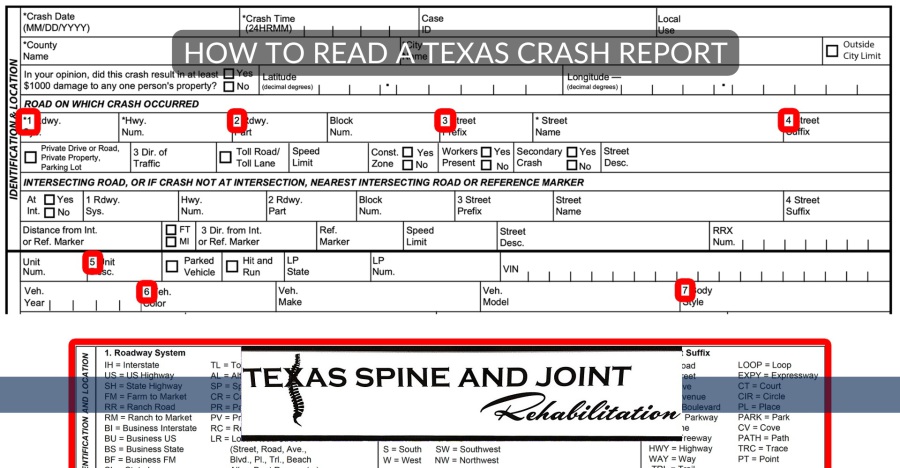
After an auto accident in Texas, one of the most important documents you will receive is the official Texas Crash Report, known as the CR 3 form. This report outlines critical details about your collision, who was involved, contributing factors, and whether any injuries were recorded at the scene. Insurance companies rely heavily on this document, which means understanding it can protect both your health and your accident claim.
As an experienced Accident Doctor, Dr. Daniel L. Pennell at Texas Spine and Joint Rehabilitation helps injured drivers decode this document and understand how it affects their next steps after a wreck. Here is a clear guide to help you decipher each major section.
1. Identifying Information
The first part of the Texas Crash Report includes general details such as the crash date, time, location, road conditions, and weather. This section confirms where and when the incident occurred. If you notice incorrect information here, it is important to address it early because insurance carriers use these details to verify every claim.
2. Unit Information
Each vehicle involved in the crash is labeled as a “unit.” The report lists driver information, vehicle type, registration, insurance details, and damage severity. This section often includes contributing factors such as distraction, unsafe speed, lane changes, or failure to yield.
If your injuries occurred in a crash where another unit was clearly at fault, the notes in this section can strongly support your case.
3. Injuries and Severity Codes
Texas uses numerical severity codes to classify injuries. These range from minor visible injuries to suspected serious injuries. Many injuries, like whiplash, ligament tears, or concussion symptoms, may not present immediately at the scene. If your crash report states “no injury” but you experience pain later, it is critical to visit an Accident Doctor promptly.
Dr. Daniel L Pennell evaluates accident related injuries that are often missed in the early stages. His documentation can help support your claim even if the crash report initially indicates no injury.
4. Contributing Factors and Conditions
This section outlines what the investigating officer believed contributed to the accident. Examples include driver inattention, alcohol involvement, weather conditions, faulty brakes, unsafe speed, or improper turns. Insurance companies review this section carefully when determining liability.
If the officer made assumptions without witness testimony or clear evidence, your attorney may dispute these notes. Having a clear medical record from an Accident Doctor strengthens your side by showing how the forces of the crash affected your body.
5. Diagram and Narrative
One of the most important parts of the Texas Crash Report is the officer’s diagram and written narrative. This explains how the crash occurred based on the available evidence. The diagram shows vehicle positions, direction of travel, and the impact point. The narrative may also include witness statements.
This section strongly influences how fault is determined. Understanding the narrative can help you explain your injuries more accurately to your healthcare provider.
6. Interpreting Damage Codes
Damage codes describe where each vehicle was impacted, the severity of the damage, and whether airbags deployed. Even low speed collisions can cause injuries that are not visible on the vehicle exterior. Texas Spine and Joint Rehabilitation routinely evaluates injuries that occur in low impact collisions, which can cause significant soft tissue and spinal problems.
7. Why an Accident Doctor Matters When Reviewing a Crash Report
A Texas Crash Report focuses on the collision, but it does not evaluate your physical condition in a clinical setting. This is where seeing an accident specialist like Dr. Daniel L Pennell becomes crucial.
An Accident Doctor can:
-
Identify hidden injuries not documented in the crash report
-
Provide objective medical findings that support your claim
-
Document pain levels, mobility issues, and imaging results
-
Provide treatment plans tailored to auto accident recovery
-
Communicate with attorneys and insurance adjusters when needed
Texas Spine and Joint Rehabilitation is dedicated to helping injured drivers understand how the crash forces affected their spine, joints, and soft tissues. Accurate medical documentation combined with your crash report can protect you if symptoms worsen or if your case is disputed by an insurance company.
8. Final Advice for Injured Drivers
If you receive your Texas Crash Report, take the time to review each section carefully. If anything is unclear or seems incorrect, bring it with you to your appointment at Texas Spine and Joint Rehabilitation. Dr. Daniel L Pennell can help you connect the details in the report with the injuries you are experiencing and ensure your recovery stays on track.
Schedule an Appointment at:
(972) 629-9181
A Receptionist is Available
24 hours - 7 days a week
✅ Same-day appointments
available
✅ We accept auto insurance and personal injury claims
✅ Walk-ins welcome
 Print
Print