Numbness and Tingling After a Car Accident: Could You Have a Nerve Injury?
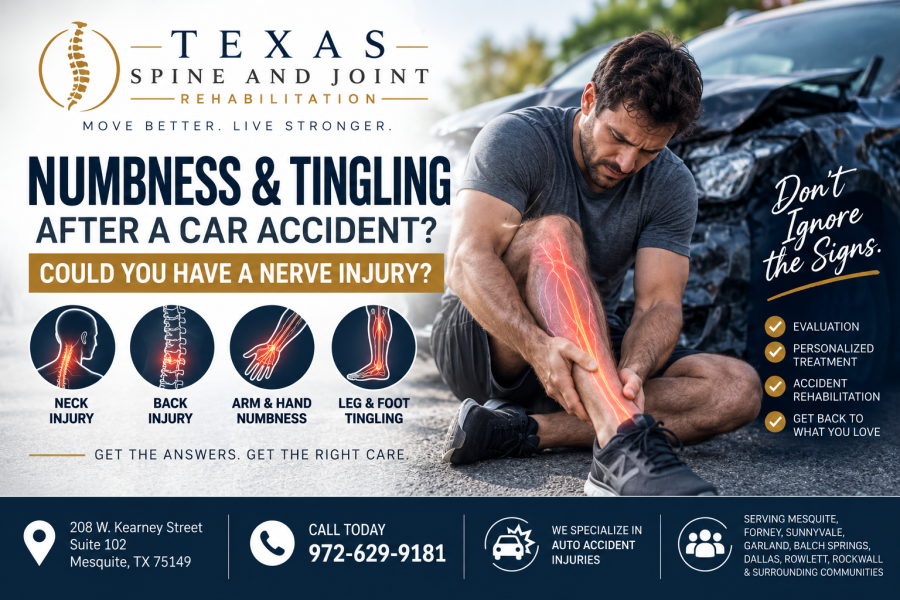
Pain is not the only symptom that can develop after a motor vehicle collision.
Some accident patients notice unusual sensations such as numbness, tingling, burning or pins-and-needles in an arm, hand, leg or foot. These symptoms may begin immediately after the collision or become noticeable hours or days later.
Unlike ordinary muscle soreness, numbness and tingling can sometimes indicate that a nerve or structure affecting a nerve has become irritated or injured.
At Texas Spine and Joint Rehabilitation in Mesquite, Texas, Dr. Daniel L. Pennell, D.C. evaluates musculoskeletal and neurological symptoms associated with motor vehicle accidents. When a patient experiences numbness and tingling after a car accident, determining where those symptoms originate is an important part of understanding the injury.
Why Can a Car Accident Cause Numbness or Tingling?
The nervous system carries information between the brain, spinal cord and the rest of the body.
Nerves originating from the cervical spine travel into the shoulders, arms and hands, while nerves originating from the lumbar spine travel into the hips, legs and feet.
During a collision, sudden acceleration, deceleration, compression or twisting can affect the spine and surrounding tissues. If an injury irritates or places pressure on a nerve, symptoms may be felt somewhere along that nerve's pathway.
Those symptoms can include:
- Numbness or reduced sensation
- Tingling or pins-and-needles
- Burning sensations
- Shooting or electric-like pain
- Pain traveling into an arm or leg
- Muscle weakness
- Changes in grip strength or movement
The location and pattern of the symptoms can provide valuable clues about which area may be involved.
Numbness in the Arm or Hand After a Car Accident
When numbness or tingling occurs in an arm, hand or fingers following a collision, the cervical spine is one area that may need to be evaluated.
The nerves that supply the upper extremities originate in the neck.
A neck injury after a car accident can affect muscles, ligaments, joints, discs and surrounding tissues. If a cervical nerve becomes irritated, symptoms may extend beyond the neck and into the shoulder, arm, hand or fingers.
A patient might experience neck stiffness together with tingling in several fingers, or pain that begins near the neck and travels down one arm.
However, not every case of hand or arm numbness originates from the cervical spine. Direct injuries to the shoulder, elbow, wrist or peripheral nerves may produce similar symptoms.
That is why determining the source requires examination rather than simply treating the area where the patient feels the symptoms.
Numbness or Tingling in the Leg After a Car Accident
The same principle applies to the lower body.
Nerves originating in the lumbar spine eventually travel into the buttocks, legs and feet.
If a back injury after a car accident irritates one of these nerves, a patient may experience pain, numbness, tingling or burning sensations extending into the lower extremity.
Some people also develop symptoms commonly described as sciatica after a car accident.
Sciatica can involve:
- Pain extending through the buttock and leg
- Tingling in the leg or foot
- Areas of numbness
- Burning or electric sensations
- Leg or foot weakness
Sciatica describes a pattern of symptoms rather than identifying the exact injury causing them.
The more important clinical question is:
What is irritating the nerve?
Could a Herniated Disc Cause Numbness and Tingling?
Yes. A spinal disc problem is one possible explanation for neurological symptoms after a collision.
Intervertebral discs sit between the vertebrae and help distribute forces through the spine. During an accident, compression, rotation and other forces can affect these structures.
A herniated or bulging disc after a car accident may irritate or compress a nearby spinal nerve.
When this occurs in the cervical spine, symptoms may extend into an arm or hand.
When it occurs in the lumbar spine, symptoms may extend into a buttock, leg or foot.
Importantly, the amount of spinal pain does not always correspond directly with the amount of nerve-related symptoms.
A person can sometimes experience significant numbness or tingling even when neck or back pain is relatively mild.
Can Whiplash Cause Tingling in the Arms or Hands?
Whiplash is commonly associated with neck pain and stiffness, but symptoms can sometimes extend beyond the neck.
The rapid movement associated with a collision can affect cervical muscles, ligaments, joints and other structures. When the injury also irritates neurological structures, a patient may report tingling, numbness or radiating discomfort into an upper extremity.
Texas Spine and Joint Rehabilitation's existing whiplash information identifies numbness or tingling in the arms among symptoms that may occur following whiplash.
This makes neurological examination particularly important when arm or hand symptoms occur alongside neck pain following an accident.
Why Didn't the Numbness Start Immediately?
Car accident symptoms are not always immediate.
The body's stress response surrounding a collision can temporarily alter pain perception. Inflammation, swelling and muscle guarding may also evolve after the initial trauma.
As injured tissues become irritated, symptoms may become more noticeable.
A patient who initially experienced only mild back or neck stiffness may later notice tingling extending into an arm or leg.
TSJR's existing accident content also recognizes that symptoms may develop hours or days following a collision.
For this reason, delayed numbness or tingling after a car accident should not automatically be dismissed simply because it was absent immediately after the crash.
How Is a Possible Nerve Injury Evaluated?
When a patient reports numbness or tingling, the examination should involve more than simply asking where it hurts.
The goal is to determine whether neurological involvement appears to be present and which structures may be contributing to the symptoms.
At Texas Spine and Joint Rehabilitation, an accident-focused evaluation may include:
- Review of the collision and symptom history
- Spinal range-of-motion testing
- Orthopedic examination
- Neurological screening
- Muscle strength evaluation
- Sensory testing
- Reflex testing when appropriate
- Evaluation of radiating symptom patterns
- Assessment of the affected extremity
- Imaging or medical referral when clinically appropriate
The clinic's existing auto-accident program includes spinal, functional and neurological evaluation, with referrals to imaging centers or other medical specialists when additional investigation is necessary.
When Is an MRI Appropriate for Numbness or Tingling?
Not every patient experiencing tingling after a collision automatically needs an MRI.
X-rays and MRI provide different types of information.
X-rays can help evaluate bones and certain structural findings, while MRI can provide more detailed information about spinal discs, nerves and other soft tissues.
An MRI after a car accident may become appropriate when examination findings suggest disc or nerve involvement, neurological symptoms are significant or progressive, or symptoms do not improve as expected.
The decision should be based on the patient's individual clinical findings rather than automatically ordering advanced imaging for every accident injury.
When Are Numbness and Tingling an Emergency?
Neurological symptoms deserve attention, but not every episode of tingling represents an emergency.
Certain symptoms, however, require prompt or emergency medical evaluation.
Seek immediate medical attention for symptoms such as:
- Rapidly increasing arm or leg weakness
- Paralysis or substantial loss of movement
- Loss of bladder or bowel control
- Numbness involving the groin or saddle region
- Significant difficulty walking
- New confusion, speech difficulty or facial weakness
- Severe neurological symptoms following significant trauma
These symptoms may indicate a condition requiring immediate medical evaluation rather than routine chiropractic or rehabilitation care.
Treating Nerve-Related Symptoms After a Car Accident
Treatment depends on what is causing the neurological symptoms.
A patient with a direct peripheral nerve injury may require a different approach than someone whose symptoms appear to originate from a spinal disc or another structure affecting a spinal nerve.
When the condition is appropriate for conservative treatment, car accident rehabilitation may incorporate chiropractic care, therapeutic exercise, mobility work and other supportive rehabilitation procedures based on the patient's examination findings.
Texas Spine and Joint Rehabilitation uses individualized accident-rehabilitation plans and can coordinate with imaging centers, neurologists, orthopedic providers and other specialists when additional evaluation is warranted.
For patients with neurological symptoms, monitoring changes in sensation, strength and function is especially important.
The goal is not simply to make the tingling temporarily disappear.
It is to determine why the symptom is occurring and what structure may be involved.
Numbness and Tingling After a Car Accident in Mesquite, Texas
Mesquite drivers regularly travel heavily used roadways including I-635, US Highway 80, I-30, Town East Boulevard, Galloway Avenue and Belt Line Road.
Whether a collision occurs during stop-and-go traffic or at highway speeds, the forces involved can affect the neck, lower back and nervous system.
If numbness or tingling begins following an accident, pay attention to where the symptoms occur, whether they travel, whether weakness is present and whether the symptoms are changing.
Those details can help determine whether the problem may involve the spine, a peripheral nerve or another injured structure.
Numbness or Tingling After a Car Accident? Start With an Appropriate Evaluation
At Texas Spine and Joint Rehabilitation, Dr. Daniel L. Pennell, D.C. evaluates patients experiencing musculoskeletal and nerve-related symptoms following motor vehicle collisions.
The clinic's Mesquite location focuses heavily on auto-accident injury evaluation and rehabilitation and can coordinate additional imaging or specialist evaluation when clinically appropriate.
If you've developed numbness, tingling, radiating pain or weakness following a collision, identifying where those symptoms originate is an important first step toward determining the appropriate course of care.
Schedule an Accident Injury Evaluation
Texas Spine and Joint Rehabilitation
208 W. Kearney Street, Suite 102
Mesquite, TX 75149
Schedule an Appointment at:
(972) 629-9181
A Receptionist is Available
24 hours - 7 days a week
✅ Same-day appointments
available
✅ We accept auto insurance and personal injury claims
✅ Walk-ins welcome
The clinic's current website confirms this address and telephone number.
Serving accident patients throughout Mesquite, Forney, Sunnyvale, Garland, Balch Springs, Dallas, Rowlett, Rockwall and surrounding communities.
This article is intended for educational purposes and is not a substitute for individualized medical advice. Severe, rapidly progressive or concerning neurological symptoms require appropriate emergency medical evaluation.
Frequently Asked Questions
Why am I experiencing numbness and tingling after a car accident?
Numbness and tingling can occur when a nerve or a structure affecting a nerve becomes irritated following a collision. Possible sources can include injuries involving the neck, lower back, spinal discs or peripheral nerves. An examination is necessary to determine the likely source.
Can a car accident cause nerve damage?
Motor vehicle trauma can affect nerves directly or injure surrounding structures that irritate or compress nerves. Symptoms can include numbness, tingling, burning sensations, radiating pain or weakness.
Why is my hand tingling after a car accident?
Nerves supplying the arm and hand originate from the cervical spine, so a neck or cervical disc injury is one possible source. However, shoulder, elbow, wrist and peripheral nerve injuries can also cause hand symptoms.
Why is my leg or foot numb after a car accident?
Numbness in a leg or foot can sometimes be associated with irritation of nerves originating in the lumbar spine. Disc injuries, sciatica and direct lower-extremity injuries are among the possibilities that may need to be evaluated.
Do I need an MRI for numbness after a car accident?
Not necessarily. MRI may be considered when examination findings suggest disc or nerve involvement, neurological symptoms are significant or worsening, or symptoms fail to improve as expected. Imaging decisions should be based on the individual patient's findings.
When should I be concerned about numbness after a car accident?
Rapidly worsening weakness, substantial loss of movement, loss of bladder or bowel control, saddle-area numbness, significant walking difficulty or other severe neurological symptoms require prompt medical attention.
Where can I get evaluated for numbness and tingling after a car accident in Mesquite?
Texas Spine and Joint Rehabilitation at 208 W. Kearney Street, Suite 102 in Mesquite provides accident-focused musculoskeletal and neurological evaluation under the direction of Dr. Daniel L. Pennell, D.C.
 Print
Print